Why Genuine Documents Are the Only Thing Standing Between You and Your Visa
By shivant gupta
June 22, 2026
A student in Patiala paid ₹2 lakh to an agent who promised a Canada study visa in 30 days. The agent arranged a bank statement showing ₹25 lakh in savings. The family had ₹4 lakh. IRCC flagged the discrepancy in under a week. The application was refused. The student received a misrepresentation finding. And now, that student cannot apply to Canada again for five years.
This isn’t a rare horror story. It happens across Punjab every admission cycle. And the worst part? The student didn’t even know the documents were faked until the refusal letter arrived.
At Sethi International, we’ve watched this pattern destroy plans for over a decade. Families spend their savings, trust the wrong person, and end up worse off than when they started not because their profile was weak, but because someone told them the truth wouldn’t be enough.
It always is.
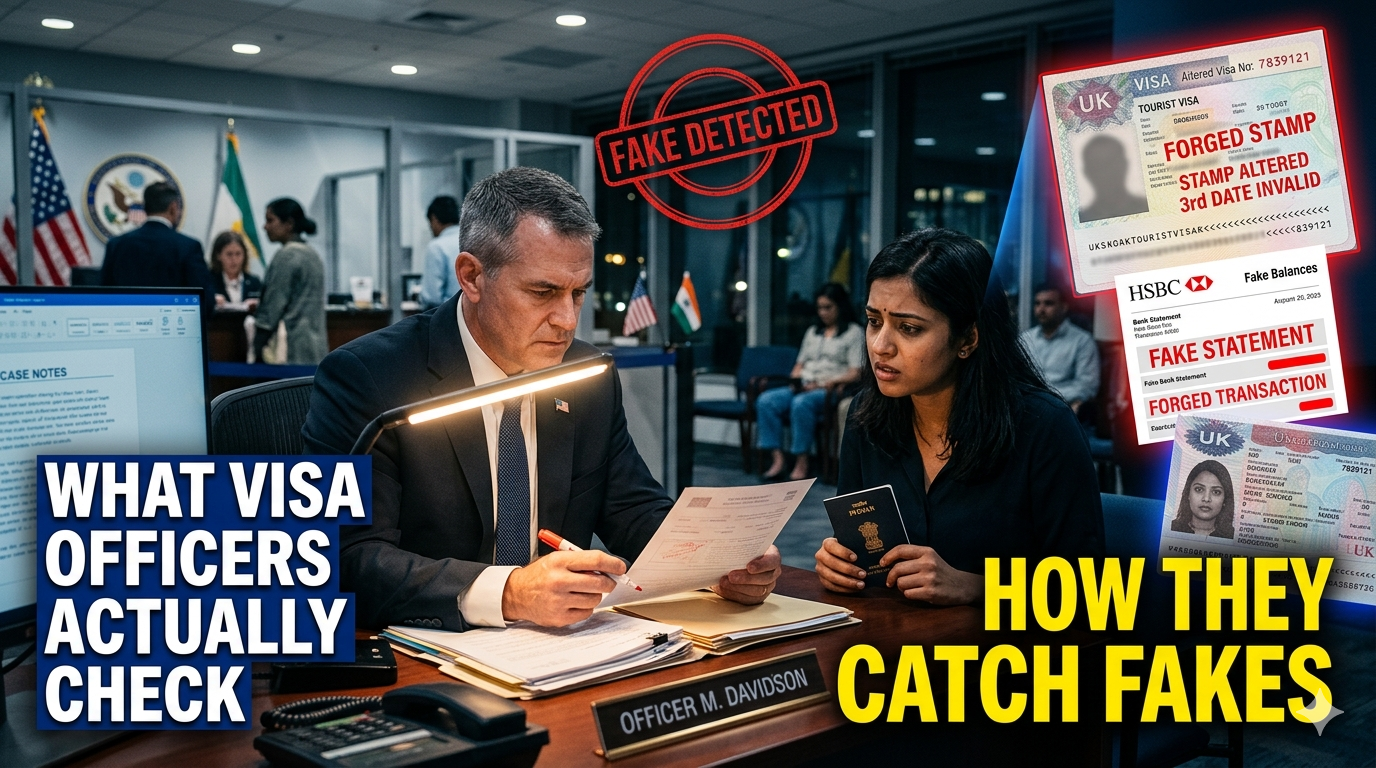
What Visa Officers Actually Check ( How They Catch Fakes)
Here’s something most applicants in Nabha, Sangrur, and across Punjab don’t realize: visa officers don’t just read your documents. They verify them.
Canada’s IRCC, the UK Home Office, Australia’s Department of Home Affairs, and the US Embassy in New Delhi all have fraud detection units that specifically handle applications from South Asia. These aren’t overworked clerks flipping through papers. They’re trained analysts with access to databases, employer directories, bank verification systems, and educational institution records.
A bank statement gets cross-referenced with the branch. An employment letter gets verified by calling the company or checking whether the company even exists. An educational transcript goes back to the university registrar. Tax returns get matched against income declarations.

And they talk to each other. Canada, the UK, Australia, New Zealand, and the US share intelligence on immigration fraud through formal agreements. A fake document submitted for a Canadian visa can follow you when you apply to Australia two years later.
The verification technology has also changed. What worked in 2012 doesn’t work in 2026. Digital watermarking, QR-code verification on transcripts, centralized tax databases linked to PAN and Aadhaar the infrastructure to catch fraud has grown faster than most applicants realize.
The Real Consequences of Submitting Manipulated Documents
Let’s be specific about what happens when fraudulent documents are detected, because “visa refusal” doesn’t capture the full picture.
Refusal with a misrepresentation finding. This isn’t a standard refusal. In Canada, a Section 40 misrepresentation finding means you’re barred from applying for any Canadian visa student, tourist, work permit, PR for five years. For families planning a child’s education abroad, that’s not a setback. That’s the entire plan gone.
UK 10-year re-entry ban. The UK Home Office applies paragraph 320(7A) for deception in visa applications. Get caught submitting a fake IELTS certificate or a fabricated employer reference, and you’re locked out for a decade. The UK Border Agency has publicly stated they maintain zero tolerance for fraud from South Asian applications; they’ve said this at joint press events with the Australian and Canadian High Commissions in New Delhi.
Australia’s exclusion periods. The Department of Home Affairs can impose a 3-year or 10-year exclusion period under Section 501 of the Migration Act, depending on the nature of the misrepresentation. They’ve invested heavily in a document verification service that connects directly to issuing institutions.
US visa ineligibility under INA 212(a)(6)(C). Misrepresentation to a US consular officer triggers a permanent ground of inadmissibility. Permanent. Not five years, not ten. You need a specific waiver which is difficult to obtain to ever be eligible again.
And here’s what people forget: the applicant is responsible for everything submitted in their name, even if an agent prepared the file. “I didn’t know it was fake” is not a defence that immigration authorities accept. The application carries your signature.
Why “Weak” Profiles Don’t Need Fake Documents
The single biggest reason applicants end up with manipulated documents is fear. Fear that their bank balance isn’t high enough. Fear that a study gap will raise questions. Fear that a previous refusal means automatic rejection.
These fears are understandable. But they’re mostly wrong.
A study gap of two years doesn’t disqualify you from a Canadian student visa. A previous refusal doesn’t automatically mean a second refusal. A bank balance of ₹8 lakh instead of ₹20 lakh doesn’t kill an application if the financial narrative makes sense if there’s a loan sanction letter, if the sponsor’s income is documented clearly, if the funds flow is logical.
What kills applications is inconsistency. When your bank statement says one thing and your ITR says another. When your employer letter claims a salary of ₹60,000 per month but your bank shows deposits of ₹22,000. When your father’s agricultural income is listed at ₹12 lakh annually but there’s no corresponding revenue in the bank account.
Visa officers aren’t looking for perfection. They’re looking for coherence. Does the story your documents tell match reality?
An experienced immigration consultant’s job isn’t to manufacture a perfect profile. It’s to take what’s real and present it clearly, accurately, and persuasively. That gap year? Explained with a one-paragraph SOP reference and a supporting document. That previous refusal? Addressed head-on in the cover letter with evidence of what’s changed. That lower bank balance? Supplemented with a properly documented education loan and a sponsor’s income proof.
At Sethi International, we’ve processed over 1,300 successful student visa applications. Not one of them required a fabricated document. Every single one was built on what the applicant actually had presented properly.
How to Tell If Your Immigration Consultant Is Honest
This is uncomfortable territory, but it needs to be said. Punjab has a consultant-on-every-corner problem. Some are excellent. Some are not. And the difference between the two can determine whether a student lands in Toronto or lands a five-year ban.
Watch for these signals:
They guarantee a visa. No consultant, no matter how experienced, can guarantee a visa. The decision sits with the visa officer, not the consultant. Anyone who guarantees approval is either lying or planning to submit documents that aren’t yours. Both outcomes are bad.
They ask for blank documents. If a consultant asks you to provide blank letterheads from your employer, blank bank documents, or your signature on empty forms walk out. There’s only one reason someone needs a blank document, and it’s not a reason that helps you.
They quote a “success fee” payable after the visa is approved. This creates a perverse incentive. The consultant makes money only if you get approved, which pushes them toward whatever it takes including document manipulation to get that approval.
They discourage you from reading your own application. You should know every single document being submitted in your name. You should read your SOP before it’s submitted. You should see your financial documents package. If a consultant won’t let you review the file, something in that file isn’t yours.
They promise unusually fast processing. Visa processing timelines are set by immigration authorities, not consultants. If someone promises a Canada study visa in 15 days when the posted processing time is 8 weeks, they’re not faster they’re lying.
What a Transparent Immigration Process Actually Looks Like
Transparency isn’t a marketing buzzword. It’s a specific set of practices that protect you.

Honest eligibility assessment before you pay. Before any fees are discussed, a professional consultant evaluates your profile against the program requirements. If you don’t meet the eligibility criteria for Express Entry, you should hear that upfront not after you’ve paid ₹50,000.
Clear documentation of fees. What you’re paying, what it covers, what it doesn’t. In writing. Before you sign anything.
You see every document before submission. Your SOP. Your financial documents. Your employer reference letters. Your educational credential assessments. Everything goes through you before it goes to the visa office.
Realistic communication about risks. If there’s a weak point in your application — a study gap, a low IELTS score, a previous refusal a good consultant tells you about it and explains the strategy to address it. They don’t hide it and hope the visa officer won’t notice. (The visa officer will notice.)
Regular updates throughout processing. You should never have to wonder what’s happening with your application. Biometrics scheduled? You know. Additional documents requested? You know. Processing timeline estimate? You know.
This is how we operate at Sethi International. Not because transparency is trendy, but because it’s the only way applications hold up under scrutiny. We’ve seen too many students come to us after a refusal caused by another consultant’s shortcuts, and the cleanup is always harder than doing it right the first time.
Previous Refusals Don’t End Your Immigration Journey
One of the most damaging myths in Punjab’s immigration corridor is that a refusal means it’s over. It doesn’t.
A refusal means the visa officer wasn’t convinced by what they saw. That’s it. It means something in the application didn’t add up maybe the SOP was generic, maybe the financial documents were incomplete, maybe the program choice didn’t align with the applicant’s background.
Every refusal comes with a reason. That reason is your roadmap.
If the refusal was about insufficient funds, the solution isn’t a fake bank statement. It’s building a proper financial package a combination of savings, an education loan sanction, a sponsor’s income documentation, and a clear funds flow chart that shows where the money comes from.
If the refusal was about weak ties to India, the answer is documenting those ties properly property records, family business involvement, a compelling return plan in the SOP.
If the refusal was about a study gap, it’s explaining what you did during that period and why your chosen program is the logical next step.
We’ve handled study visa applications for Australia, Canada, the UK, New Zealand, and the USA including many cases where the student had been refused previously. The second application succeeded not because we invented new facts, but because we presented the real ones properly.
Your Visa Application Is a Legal Document| Treat It Like One
Here’s a perspective most 19-year-olds filling out visa forms don’t have: your visa application is a legal declaration. When you sign it, you’re certifying under penalty of law that everything in it is true.
That’s not a formality. Immigration authorities in Canada, the UK, Australia, and the US treat visa applications as sworn statements. Misrepresentation in a visa application can be prosecuted as fraud. In India, agents involved in visa fraud face prosecution under BNS Sections 336 and 340 (formerly IPC 420, 467, and 468), with imprisonment of up to seven years.
The legal weight of a visa application is why genuine documentation isn’t just an ethical preference it’s a practical necessity. Every document you submit needs to withstand verification. Every statement in your SOP needs to match your supporting evidence. Every financial figure needs to trace back to a real source.
This is also why choosing the right consultant matters. At Sethi International, we don’t just prepare applications, we build cases. Every document is cross-checked internally before submission. Every SOP is reviewed against the applicant’s actual background. Every financial package is stress-tested for the same inconsistencies a visa officer would look for.
Because the goal isn’t just getting a visa. The goal is building an immigration record so clean that every future application, work permit, PR, citizenship, family sponsorship stands on a foundation of verified truth.
That’s what integrity does. It doesn’t just solve today’s problem. It protects every opportunity you’ll have tomorrow.
Sethi International has been helping students and families from Nabha, Sangrur, and across Punjab with genuine, transparent immigration services for over a decade. If you’re considering studying abroad or immigrating, get in touch for an honest assessment of your profile no shortcuts, no false promises.