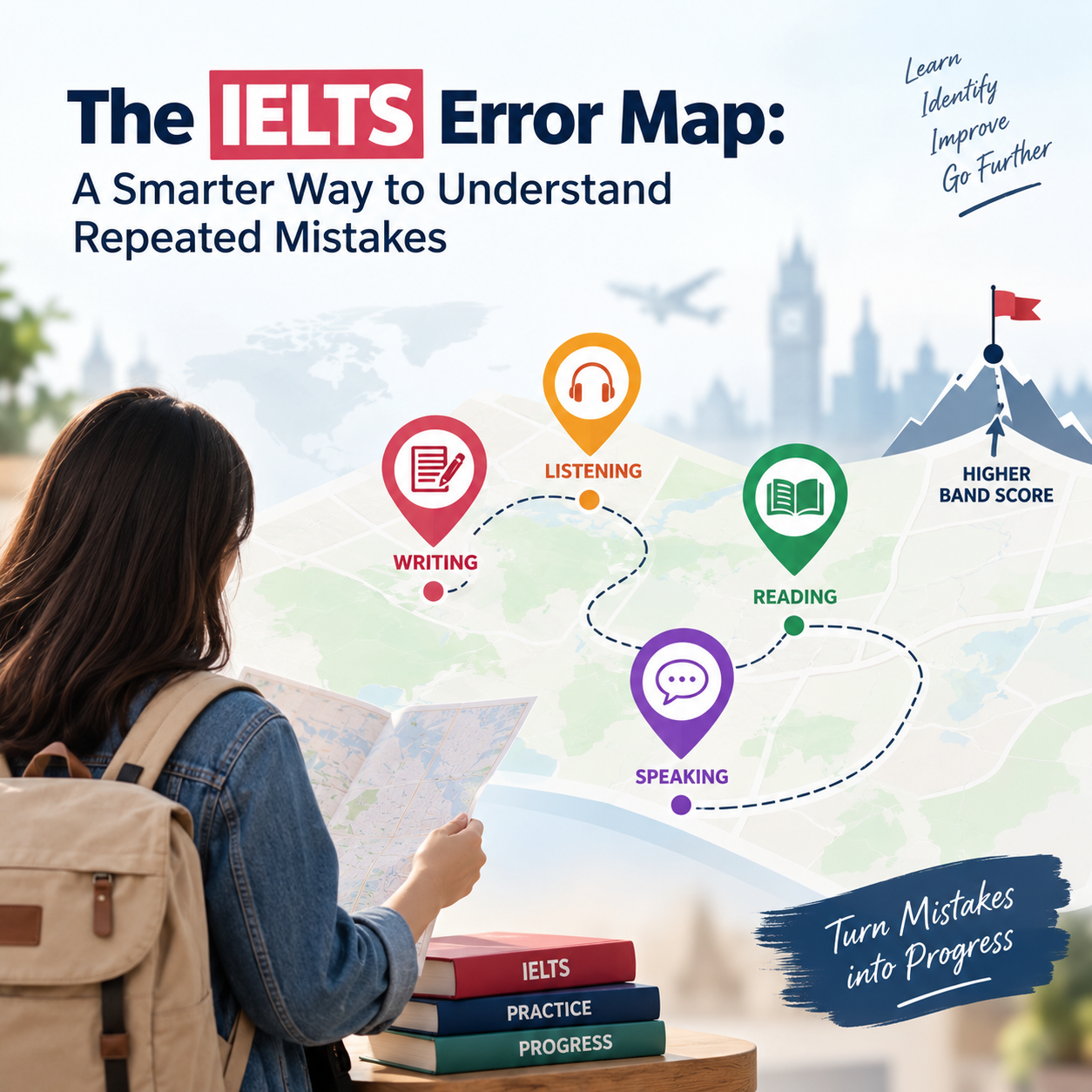
The IELTS Error Map: A Smarter Way to Understand Repeated Mistakes
By seo_expert
August 27, 2026
Preparing for IELTS often means completing practice tests, learning vocabulary, reviewing grammar, and improving speaking skills. Yet some students practise for weeks without seeing the expected improvement. One reason is that they notice mistakes but do not study the pattern behind them.
An IELTS error map offers a focused approach. It turns incorrect answers into useful information. Instead of asking only how many questions were wrong, students can ask why they were wrong, how often the same problem appears, and what practice can prevent it. For students considering the Best IELTS Coaching in Sangrur, this method can make preparation more organised.
What Is an IELTS Error Map?
An IELTS error map is a personal record of mistakes made during preparation. It can include errors from Listening, Reading, Writing, and Speaking. The purpose is not to collect mistakes endlessly but to identify patterns.
For example, a student may repeatedly miss Listening answers because of spelling. Another may choose Reading answers after noticing one matching word without understanding the complete meaning. A Writing student may repeatedly make errors with articles, verb tenses, or sentence structure.
When these problems are recorded, they become easier to recognise and target.
Why Repeated Mistakes Deserve Attention
One wrong answer is not necessarily a serious concern. Repeating the same mistake, however, can indicate a weakness that needs specific practice.
Consider a student who regularly loses marks in Reading because of True, False, Not Given questions. Completing another full test may create more practice, but it may not explain why the errors occur. The student may need to understand the question type, distinguish stated information from assumptions, and review incorrect answers carefully.
Start With a Simple Error Log
An error map does not need to be complicated. After each practice session, record the question, your answer, the correct answer, and the reason for the mistake.
Avoid writing only “wrong.” Add a useful explanation. You might write, “I selected the option because I focused on a similar word rather than the meaning.” For grammar, write, “I used the past tense although the sentence For Speaking, check if you stopped too soon, repeated words, or found it difficult to explain an idea. Also, note when you were expressing a general fact.
These observations are more useful than a score alone.
Separate Errors by IELTS Skill
Divide your error map into four sections: Listening, Reading, Writing, and Speaking.
Listening mistakes may involve spelling, concentration, missed information, unfamiliar pronunciation, or difficulty following a conversation.
Reading mistakes can include misunderstanding question types, missing details, relying on matching words, or struggling with paraphrased information.
Writing problems may involve task response, organisation, vocabulary, grammar, spelling, or punctuation.
Speaking difficulties may include hesitation, repetition, pronunciation, limited vocabulary, or difficulty extending an answer.
Find the Cause, Not Just the Error
The most valuable question in an error map is “Why did this happen?”
Suppose a student repeatedly writes a familiar word incorrectly. The issue may not be vocabulary knowledge but spelling. In that case, focused spelling practice may be more useful than completing another vocabulary list.
Similarly, if a student frequently uses incorrect articles, reviewing article rules and applying them in original sentences may be more effective than memorising corrected examples.
IELTS preparation becomes stronger when students work on the source of an error instead of repeatedly correcting the same surface mistake.
Rank Your Mistakes
Not every error deserves equal attention. After several practice sessions, count how frequently each category appears.
You might find that verb tense errors occur ten times, article errors seven times, and spelling errors three times. The most frequent problems can become your first priorities.
This approach prevents students from spending too much time on occasional mistakes while overlooking weaknesses that repeatedly affect performance.
Use an Error Map for Writing
Writing benefits from structured error analysis because performance is assessed across specific areas. IELTS Writing assessment considers task achievement or task response, coherence and cohesion, lexical resource, and grammatical range and accuracy.
Your error map can therefore include four Writing categories.
Under task response, check whether every part of the question was answered and whether ideas were sufficiently developed.
Under coherence and cohesion, examine paragraph organisation, logical progression, and connections between ideas.
Under lexical resources, record inaccurate word choices, unnecessary repetition, and vocabulary that does not fit the context.
Under grammar, track recurring problems such as articles, prepositions, verb forms, agreement, and sentence structure.
This makes feedback easier to turn into practical action.
Create a Personal Grammar Map
Grammar improvement is often more effective when it is specific. Instead of saying, “My grammar is weak,” identify the exact patterns causing problems.
Create categories such as articles, prepositions, verb tenses, subject-verb agreement, conditionals, countable nouns, and sentence structure. Each time an error appears, add it to the relevant category.
Then practise one weak area at a time. Write original sentences using the target structure and check whether the same mistake appears again. Later, use that structure in a paragraph or speaking response.
The goal is to make correct grammar part of natural communication.
Review Listening and Reading Errors
After a Listening or Reading test, do not immediately move to the next paper. Review every incorrect answer.
For Listening, identify whether the problem involved spelling, concentration, prediction, unfamiliar pronunciation, or missing information.
For Reading, ask whether you misunderstood the question, overlooked a detail, confused similar information, or failed to recognise a paraphrase.
Also examine questions you answered correctly by guessing. A guessed answer may indicate a weakness even though it did not reduce your score that time.
Turn Mock Tests Into Learning Tools
A mock test should provide more than a number. It should tell you what to practise next.
After each test, compare new mistakes with previous entries in your error map. If the same category continues to appear, give it focused attention. If a problem becomes less frequent, move to another priority.
This makes each practice paper part of a continuous improvement cycle rather than another isolated exercise.
Avoid Memorising Correct Answers
Memorising corrections may provide a short-term benefit, but understanding the reason behind a correction is more valuable.
If a Reading answer was wrong because you misunderstood a paraphrase, remembering the correct option will not prepare you for a new question. If a grammar sentence was corrected, understand the rule and create different examples.
The purpose of an error map is to develop awareness that can be applied to unfamiliar questions.
Conclusion
An IELTS error map turns repeated mistakes into a practical preparation strategy. It helps students move beyond simply completing more tests and encourages them to understand what is actually limiting their performance.
If you are considering the Best IELTS Coaching in Sangrur, look for preparation that encourages analysis, feedback, and targeted practice rather than relying only on the number of mock tests completed.
Record mistakes from all four IELTS skills, identify their causes, group recurring problems, and prioritise the areas that appear most often. Review your practice regularly and adjust your preparation according to the evidence.
The key is simple: do not treat every mistake as a setback. Treat it as information. When you know what went wrong, understand why it happened, and practise the correct skill deliberately, your preparation becomes more focused and productive.